auditomat® at ASSA ABLOY Mercor Doors
ASSA ABLOY Mercor Doors is a leading manufacturer of steel technical doors, fire doors, and…

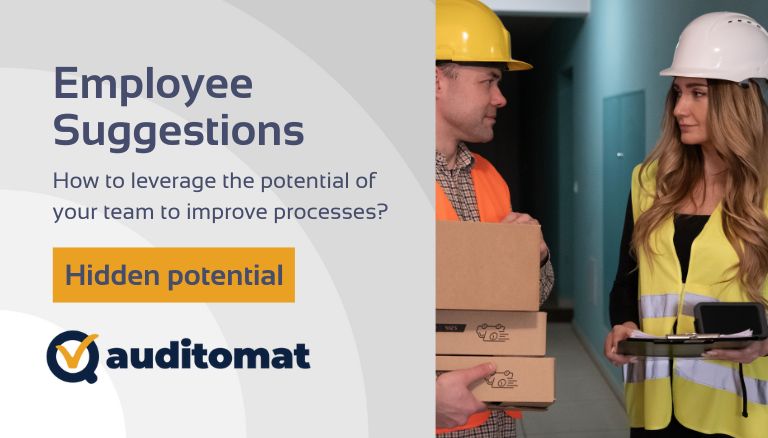
Active involvement of employees in improvement processes is becoming a key element of effective management. Employee suggestion programs, which allow workers to submit improvements, are gaining popularity in Polish enterprises. A study conducted on 249 respondents from various companies using continuous improvement methodologies showed that over 80% of them have implemented such programs. The main reasons were the desire to improve the company, employee engagement, and cost reduction.
An analysis of employee motivation revealed that rewards for submitted applications and the improvement of working conditions are crucial. Active support from management is also essential. Over 50% of respondents indicated financial rewards as preferred, often linked to savings. In reality, about 20% of companies use non-monetary rewards.
An effective evaluation system for submissions is key. In most companies, evaluation is internal, involving Lean and HSE (Health, Safety, and Environment) departments. Suggestions are categorized and, in some firms, scored based on savings, ergonomics, safety, and environmental impact.
The goal of our article is to analyze employee suggestion programs in Polish companies, their impact on innovation, and to present best practices. See for yourself how to use a modern auditing system for this purpose.
Based on research from the Gdańsk University of Technology, employee suggestions are a formal system within which employees have the opportunity to submit their ideas and proposals for improvements in the organization. These can relate to various aspects of the company’s activities, such as:
This issue was perfectly formulated by Adam Lewiński in “Employee suggestion program as a way to engage employees in improving business processes.” The author explains the deep relationships connecting Lean management and Kaizen into a whole that gives employees a platform for continuous process improvement. The ability to effectively improve business processes is a key success factor. To maintain their position, companies must constantly adapt to dynamically changing conditions using various methods based on a process approach.
For example, ISO 9001:2015 defines the process approach as “the identification and management of numerous linked activities.” In this case, process management enables more effective identification of activities that create value for the customer, leading to increased company efficiency and customer satisfaction. Consequently, many concepts based on this approach have emerged, such as TQM (Total Quality Management), Lean Management, Six Sigma, and ISO Quality Management Systems.
The concept of Lean Management, originating from Japan’s Toyota Motor Corporation, emphasizes continuous improvement. A key element of the Toyota Production System is the active involvement of employees at all levels of production to eliminate waste. It is there that the employee suggestion system serves as one of the methods motivating employees to improve the work environment.

The Gallup Institute, a global leader in employee engagement research, reveals alarming data. Their analysis shows that globally, only 21% of employees are fully engaged in their work. In Poland, this percentage is even lower at just 14%.
Consider how much value companies lose by ignoring the potential of 86% of their employees who are not fully engaged. This is a massive loss affecting innovation, productivity, and overall organizational efficiency. Furthermore, Gallup’s research shows that 19% of employees worldwide are “actively disengaged.” These individuals feel undervalued and frustrated, and their negative attitude can sabotage the efforts of engaged colleagues.
These data represent a serious challenge for leaders. They require concrete actions to unlock hidden potential and build a culture of engagement that benefits both the employees and the organization.
How to implement an effective employee suggestion program?
Implementing an effective program can be a powerful tool for supporting innovation and raising morale. Success depends on careful planning, implementation, and ongoing evaluation.
Analysis of a real-world case study from the Gdańsk University of Technology shows that a pilot project was conducted before full implementation. Employees submitted ideas for improving workplaces; the most interesting proposals were rewarded, and a process improvement team was responsible for execution.
Promising Start and Early Successes The program quickly gained recognition. Suggestion forms, analyzed by specialized committees, became an important communication tool. Managers of specific areas made the implementation decisions. As a result, 15% of proposals were implemented, and 26% were accepted and awaiting implementation. However, 59% were rejected.
Challenges and Decline in Activity In the following year, a significant drop in the number of ideas was observed—nearly half compared to the previous year. Although the 15% implementation rate held, the number of ideas awaiting realization dropped to 13%, and the rejection rate rose to 73%. Key problems included long implementation times for accepted ideas and the overloading of the process optimization unit, which negatively impacted the timeliness of feedback.
Implementing an employee suggestion system brings several benefits:

A properly constructed system allows for the utilization of the crew’s potential and the generation of innovative solutions.
Employee suggestion programs are a key tool for building an innovative and efficient organization. Success depends on clear rules, management commitment, employee motivation, and rapid feedback.
Companies must constantly improve to remain competitive. An employee suggestion system, supported by modern tools like the auditomat® auditing system, can significantly contribute to this goal.