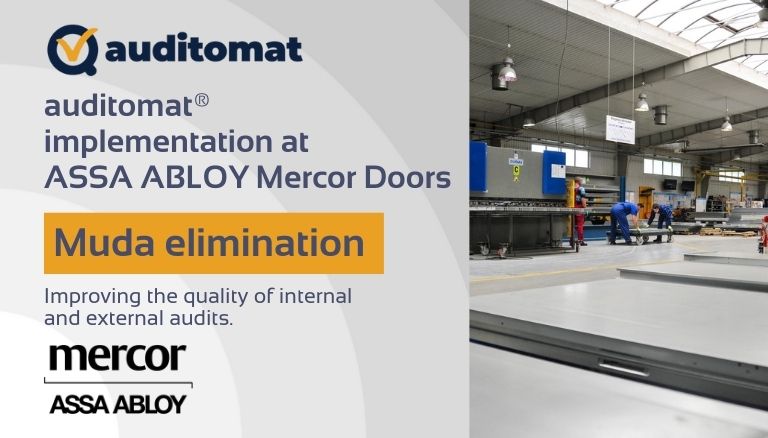
auditomat® at ASSA ABLOY Mercor Doors
ASSA ABLOY Mercor Doors is a leading manufacturer of steel technical doors, fire doors, and…

In today’s highly competitive environment, companies are constantly seeking proven optimization methods. 5S is traditionally associated with quality improvement and reduced environmental impact, but it is also gaining popularity as a tool to enhance competitiveness. For example, at Fiat Auto Poland S.A., as part of an integrated World Class Manufacturing system, 5S is a key element in eliminating waste and achieving global competitiveness. This system, which integrates tools such as Green Cross, S-Tag, AM-Tag, Poka Yoke, 5Why, 7M, and One Point Lesson, demonstrates that 5S supports the company’s strategic goals. In this way, 5S becomes part of broader processes that impact overall performance and cost improvement.
A similar example can be found at Volkswagen, where continuous improvement workshops (PCU) demonstrate the effectiveness of 5S in generating measurable savings. For instance, Ford reported savings of 3.5 million PLN, which increased to 4.5 million PLN after switching to a manual scale. These results, while impressive, are only part of the benefits. The impact of 5S on ergonomics and employee health, which also contributes to efficiency and team morale, is equally significant.

This article explores the practical application of 5S in the automotive industry, using Volkswagen as an example, as well as in logistics. We will show how 5S contributes to tangible financial and operational results and improves working conditions.
Although 5S originates from Japanese industry, it has become a universal tool for optimizing space and processes. Its simplicity and effectiveness make it applicable in almost any environment, from manufacturing to offices. However, a key question remains: where should a 5S audit be conducted to achieve maximum benefits?
Examples of where 5S audits can be applied:
According to 60% of respondents, the main reason 5S fails is lack of time, highlighting the need for better planning and work organization to enable employees to maintain 5S standards. Other reasons include lack of coordination (24%) and insufficient employee training (13%). These findings come from a survey conducted by the Faculty of Production Engineering at the University of Life Sciences in Lublin.

Between 2010 and 2012, Nicols Polska began implementing 5S elements, but without a cohesive strategy for the entire plant. Initiatives were carried out individually by department managers.
In Q3 2012, the company’s management formally decided to prepare for a comprehensive 5S implementation. In Q4, initial training sessions were conducted for all staff, and in early 2013, pilot workshops focused on the 3S elements (Sort, Set in order, Shine). “5S Days” were introduced to reinforce new habits.
In June 2013, a workstation audit system was implemented to ensure 5S compliance, integrated with GMP standards. After a year, the company modified the audit scoring system, eliminating half-points and introducing a split into corrective actions: quick (immediate) and serious (quarterly).
The SOS concept (Sicherheit-Ordnung-Sauberkeit – Safety-Order-Cleanliness), implemented at Volkswagen Poznań Foundry, is an integral part of the production system focused on continuous process improvement. This is a local adaptation of 5S principles through rigorous cleanliness and order standards. SOS focuses on four key areas: customer, people, product, and environment, aiming to:
SOS effectiveness is regularly monitored through audits, which, if discrepancies are found, result in corrective action plans. 5S audits often focus on individual workstations, emphasizing employee engagement. A one-time implementation does not guarantee success, making ongoing monitoring essential.
Conducting a 5S audit is key to maintaining order and efficiency at work. auditomat® is a comprehensive platform designed to streamline and automate audit processes, ensuring compliance with standards and regulations. It offers features for planning, conducting, and analyzing audits, as well as managing nonconformities. Steps to perform an effective 5S audit include:

A 5S audit is a key process optimization tool used across industries—from manufacturing to logistics to the public sector. Examples from Fiat Auto Poland, Volkswagen, and Ford show that 5S not only reduces waste and lowers costs but also improves workplace ergonomics, safety, and team morale.
Want your company to achieve similar results? Don’t wait! Start implementing 5S audits today. Use modern tools like auditomat® to simplify the audit process, increase efficiency, and ensure continuous improvement.