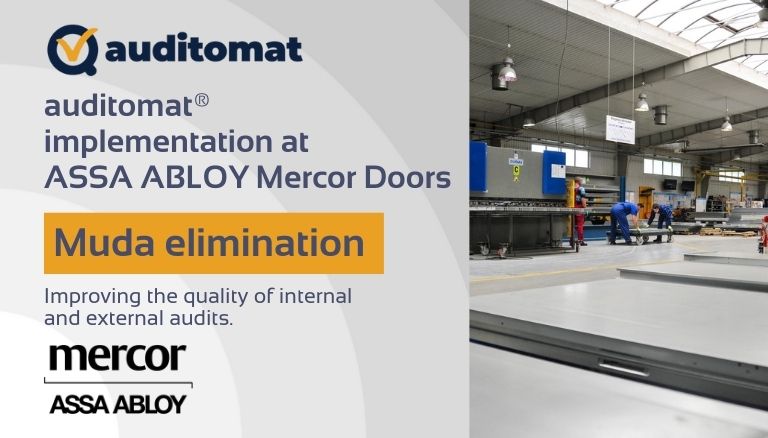
auditomat® at ASSA ABLOY Mercor Doors
ASSA ABLOY Mercor Doors is a leading manufacturer of steel technical doors, fire doors, and…


What is Gemba Walking? Why is it Worth Conducting Gemba Walks? Gemba Walk: An Example in the Pharmaceutical Industry – see more below!
In the pursuit of operational excellence, the concept of “Gemba Walks”—going to the “actual place” where work is performed—offers a powerful approach. By adopting Gemba Walks as a daily routine, companies can improve internal operations directly on the front line.
Drawing inspiration from industry leaders like Toyota, where employee-led improvement suggestions achieve implementation rates exceeding 90%, we know that Gemba Walk can significantly boost operational excellence.
The unorganized, often chaotic work of a modern warehouse is a constant battle against unpredictable demand. Workload fluctuations can be staggering, reaching up to 50%. This trend is becoming more common daily, making traditional workforce management strategies inadequate. Lean management techniques, including Gemba Walk, can unlock up to a 15% increase in productivity. By stepping directly onto the warehouse floor, observing processes in real-time, and engaging employees, leaders can unlock hidden potential for process optimization.
In this article, we reveal more about Gemba Walking. Check out the 10 rules and learn how to improve your company’s operations.

The Japanese term Gemba means “the actual place.” Jim Womack, author of the book Gemba Walks, expands this definition by calling Gemba the place in an organization “where people create value.” Gemba is a well-defined element of the Lean concept and, as such, an accepted tool for operational improvement in many industries that have adopted Lean principles. The famous Toyota Production System has used Gemba walks for decades. However, in the pharmaceutical industry, the Gemba concept has not yet been widely implemented.
The concept is strikingly simple. Womack, the guru of Gemba walks, describes it as: “I just walk around, comment on what I see, and encourage people to try.” However, in the pharmaceutical industry, one often hears complaints that supervisors—not to mention management—rarely have time to go out to the production floor or laboratories where they could interact with employees and observe what is actually happening.

Gemba walks demonstrate visible management commitment to all members of the organization. They allow plant management to convey clear messages through open and honest dialogue and to gain a real picture of the progress of behavioral changes at all levels. They empower employees because their contribution to the plant’s results is recognized, and their ideas for continuous improvement are heard.
After an in-depth review of practices in this area, the Gemba Walks sub-team believes that Gemba walks should replace—or at least significantly reduce—traditional conference-style meetings, thereby minimizing the production of numerous charts and reports created solely for such meetings.
Our starting point in outlining these Gemba best practices is defining what a Gemba walk is and what it is not within the context of the pharmaceutical industry. Understanding these differences is a key success factor for a Gemba program in any industry.
It is crucial to create a Gemba walk schedule that covers all areas to be visited during the walk, or rather, the Gemba audit. The best practice is to create an annual schedule so that walks are a priority in everyone’s calendar. Consider, especially at the beginning, implementing a metric to measure participation and adherence to schedules.
Once Gemba walks are embedded in the plant’s culture, this metric can be modified to measure the effectiveness of the walks—for example, by tracking the number of implemented improvements.
A frequently cited benchmark in the pharmaceutical industry regarding the amount of time managers should spend on the production floor is 60%. This is essentially just as valid for other industries. We recognize that many pharmaceutical plants conduct Gemba Walk using a specific segment of questions on a checklist.
Examples of specific questions used in Gemba Walks in the pharmaceutical industry:
In the pursuit of continuous improvement, direct engagement and observation at the workplace—Gemba—are key. The following Gemba Walk rules, inspired by Lean leadership, aim to create a culture where every employee is an active participant in the improvement process.
The auditomat® system is a web application that serves as a support tool for the Gemba Walk process. By streamlining and standardizing audits conducted at the “actual place” of work, its main goal is to transform traditional paper checklists into an interactive, mobile solution.

Gemba Walks are not just a method, but a management philosophy based on direct engagement. In the pharmaceutical industry, implementing Gemba Walk principles can bring revolutionary changes. By consistently applying these 10 key rules, leaders can build a culture of continuous improvement where every employee feels valued and engaged.
Apply Gemba Walk principles and see your team’s efficiency, quality, and satisfaction grow. Start today using tools like auditomat® to help you standardize and digitalize your audit processes.