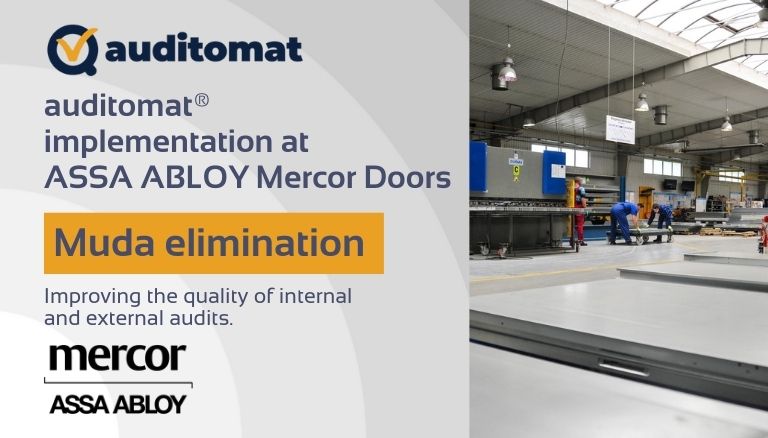
auditomat® at ASSA ABLOY Mercor Doors
ASSA ABLOY Mercor Doors is a leading manufacturer of steel technical doors, fire doors, and…


At the turn of the years, the Layered Process Audit was developed in parallel in the automotive industry by DaimlerChrysler and Toyota. Today, the requirement to apply LPA is increasingly imposed on suppliers by manufacturing companies operating within the Original Equipment Manufacturers (OEM) system.
Some companies are able to demonstrate a positive impact from implementing a Layered Process Audit (LPA), reporting up to a 20% improvement in internal return costs and a 25% reduction in complaint-related costs. Organizations clearly attribute this success to the transparency of LPA—an audit approach that enabled process optimization between production departments and industrial engineering teams.
Layered Process Audits (LPA) strongly support Lean Management objectives. They ensure compliance with standardized processes and eliminate deviations that lead to defects and waste. In addition, they promote a culture of continuous improvement through systematic audits. Learn more. An audit is not an inspection:

A Layered Process Audit (LPA) is a method for improving processes and specifications while increasing productivity. LPA evaluates whether processes are being carried out in accordance with established requirements. Thanks to its three-layer structure, LPA engages employees at all levels of the organization—from line operators to top management—creating a comprehensive system of control and improvement.
The Layered Process Audit (LPA) is applied in practice across various industries, delivering tangible benefits to many sectors.
Importantly, in the context of manufacturing efficiency, LPA is becoming a critical tool in response to growing challenges. Medium-sized plants lose an average of 25 hours per month due to downtime, and the cost of unplanned hourly downtime often increases by as much as 50%. Implementing LPA—through systematic process control and improvement—is therefore essential to minimizing these losses and increasing overall productivity.

Conducting an LPA audit can be divided into three key elements across specific stages of implementation:
LPA is based on specific requirements and expectations that processes must meet to ensure quality. In a distribution center, for example, this may include an organized goods receiving station in accordance with 5S principles, verified across multiple responsibility levels for compliance with standards.
These criteria and standards derive from various sources, including customer specifications, industry standards, regulations, and best practices. Another example is SOPs (Standard Operating Procedures), where a company requires a distribution center to follow specific rules, such as registering goods in the warehouse system from the moment a truck is unloaded. These standards define the framework for determining which aspects should be audited and how audits should be conducted effectively.
Within audited processes, certain steps or stages are particularly significant and directly impact quality. These critical control points are locations where defects or errors may potentially occur or be detected. Through in-depth analysis and evaluation, inspection methods are established to identify these control points, guiding auditors on where to focus during the audit.
To facilitate and standardize the audit process, well-designed checklists and audit templates are used. These tools are developed based on defined audit criteria, standards, critical control points, and inspection methods. They provide a comprehensive list of questions, items, or criteria that auditors use to assess compliance and verify performance during the audit. Additionally, they offer a structured format for documenting and reporting audit results.
As the name suggests, “layered” refers to different management levels within the analyzed process where LPA is implemented. A “process audit” is a proven form of assessment aimed at identifying whether processes are carried out as intended and whether desired results are achieved.
Implementing a Layered Process Audit (LPA) delivers tangible benefits, including:
Improper, uncoordinated, and multi-dimensional management of employees and processes leads to waste—primarily resulting in higher operating costs and deteriorating customer service quality.
Analyses show that employees waste up to 40% of their working day on non–value-added activities. These include manual completion of checklists or reports on paper or in MS Excel spreadsheets. Work interruptions can amount to two to three hours per day, with an additional hour spent on unnecessary travel.
According to the Pareto principle, 80% of improvement can be achieved by eliminating 20% of the root causes of poor performance. However, to effectively monitor work, not only a process is needed, but also a system that helps record daily activities.
Audit processes can be automated using auditomat®—a tool that increases efficiency and provides a competitive advantage. The system enables effective work automation, eliminating unnecessary notes, photo copying, and time-consuming result analysis.

Layered Process Audit (LPA) is not just an audit tool—it is a strategic approach to continuous improvement that delivers measurable benefits to organizations. LPA forms the foundation of effective process management. Its three-level structure engages employees at all organizational levels, fostering accountability and collaboration.
Maximize the value of your LPA by automating audit processes with auditomat®. Our solution eliminates unnecessary paperwork, centralizes data, and provides real-time access to information. With an intuitive interface and mobile access, audits become faster, easier, and more efficient.
Contact us today to learn more about auditomat® and start transforming your audit processes.